Brief Periods of Weightlessness

Image 1

Beating down against the tarmac, the rocket’s engine propels the airship into the Mojave Desert’s sky, spaceward. Made for monied tourists, it shoots upward, because Alaska’s ice mountains, remote wilderness and bending time is not enough. Enough might be this: six figures for a skip through space, a brief period of weightlessness.

On the other side of the Pacific, in Macau—long known for its drug trafficking—casino stocks are falling. Falling, falling, falling. Yet the American run Macau gambling enterprise expands as wealthy Chinese businessmen hide in foxholes while other powers put on the squeeze. Hide and seek. Like cats and mice only we don’t know who is who. They’ve been mixing cocktails together for a coon’s age.

Not far from the Americas’ Mothership of gaming, two test pilots man the rocket, or plane, or whatever it is—an amalgam of both—in the Mojave. Aeronauts ride first—point men for the outer-atmosphere tourists. A tweet tells the world they are airborne. Minutes later, the desert floor is sprinkled with metal scrap. A dead pilot still strapped to his seat.

Five years of rapid growth—fueled by none other than Las Vegas financiers—lands Macau a dubious award: world’s largest gambling center.  Shadowy characters haul in the high rollers, extend credit and collect the debt. Some of the rollers never return, their chips down.

The cost of doing business:  “in-flight-anomolies,” explosions, thugs, drugs, profiteering. Is life so bleak and sobering that our best alternative, our only option, awaits in the bosom of an interstellar bubble? Because this is where we are headed, isn’t it? Until then, we’ll take the succor of hyper-oxygenated casinos. Staying here for any length of time, though, is a gamble. A game of chance, and the stakes are, you might say, skyrocketing. How long can we accommodate ourselves? How long can we bear ourselves? So perhaps the other last frontier: the stars, the moons and the planets with their own ices and gases—or better, an exoplanet in the potentially habitable Goldilocks Zone, twenty light-years from Earth—aren’t such a long shot after all.

Gravity—an invisible force of attraction—is what keeps us tethered to earth. And the pressure of this gravity, all the bodies exerting their force upon other bodies, upon the Earth, is what scares us most, what keeps us moving away from it. Who knows when it will happen, this sudden and imminent planetary collapse, the liquidation of humankind.

An ideal space would be one in which we are tethered to nothing and nothing is tethered to us. Where matter does not matter. Where the physical world does not constrain. Cloud nine would be perfect.

To be unweighted, unfettered, light as a leaf.

The more remote the body the less the gravity.

Go faster, go higher, not west! I wonder what we will do when we reach the next unspoiled frontier. What will we do without gravity?

I Remember Tomorrow

Image 6

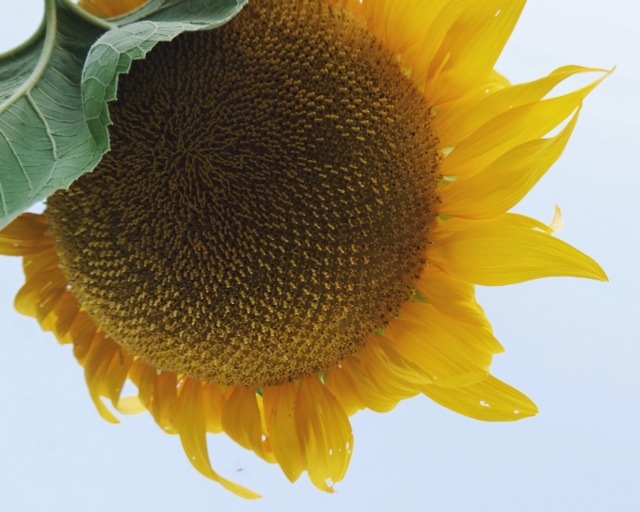
The sunflowers were put to bed, you know. I mean, literally put to bed. Their heads were lobbed off, stalks cut at the ground, and their big round discs, bulging with seed, laid in one of the wood-framed flower beds. One day, toward the end of  last month, I set out to Franklin Farm wondering if the sunflowers were still there, if they hadn’t toppled over from their own hardened weight, or been purposely cut down by one of the volunteers prepping for the winter months. What I found was that they had been deadheaded. They’ve been slain, I said to my kids. I was mortified and, well, sad. I felt out of sorts. I felt like I was ten-years-old again, and I hadn’t been prepared. No one prepared me for this event. They are sunflowers! I know, I know, they are not human, but they are theys! And, well, I had become attached to them. And I wasn’t prepared.

Of course, the feeling was fleeting. (Sort of.) As I am fully aware of the natural cycle of things, the arc of a life. Yet, I hadn’t thought it was time. Hadn’t imagined that they’d be laid to rest so soon.

It is my birthday today. I am fifty-three. Fifty-three. To my teenaged children, a number that signifies antiquity. Yesterday, I took a picture of the giant wall of wild grape leaves that climbs up a row of maples in our backyard and screens the land and the brook running behind it. It’s a glorious canvas which, all summer long and into autumn, hides the view of the adjacent street. Yesterday, the leafy wall was a mottled mass of reds and greens and golds that, brushed against the sky’s diffuse lighting, looked as if it had been painted by a French impressionist. This morning, I woke and went directly downstairs to find that, but for a few stubborn leaves, our natural wall of privacy is gone.

I don’t need to point out the obvious metaphor. But there it is, and I cannot help but address it. Look, the leaves have departed. Disappeared. Vanished. Though I can smell their earthy aroma in the air. And yet, as I look closer, some leaves are still clinging to branches like babies to mama’s breast, not knowing that the milk has dried up. Mama is tired.

Today is not like yesterday. Tomorrow the wall will be even thinner. I am reminded of this conundrum every October. Autumn’s vibrant landscape is utterly gorgeous and inspiring, but it is a set up, a prelude, an inauguration for the (inevitable) darkness of winter. In New England, we excitedly anticipate the fall season. We are thrilled by its coming. We embrace and celebrate the spectacle, the pink morning light, early evening’s crimson and amber sky, and the cool, crispness of night. But the season’s contrasts—its beauty and brittleness—remind us that it’s short-lived. And so we are inured to its passing even if many of us mourn it.

I am not the same person I was yesterday. I am not the same person I was in my forties or thirties or twenties. I think, though, that I am, or have become, or rediscovered, the person I was when I was ten. Ten. And what a joy to be ten! And how to be ten! (Though at ten, I had a memory.) I better remember myself at ten than at forty. Why? Simple. I was vibrant then. At ten, I was flash of red, streak of umber, gilt-edged silver. At forty—an age at which many women claim they come into themselves—I was warming milk bottles and wrapping dirty diapers into tight triangles for efficient disposal. I was baby food, a sallow pea green. Overwhelmed, exhausted, uncertain, bland.

Changing seasons, changing colors, passing months and years. And I am ten again. The first, magical double digit. I am writing, creating, and engaged like I was when I was ten. I am excited! This is good news as I can’t mourn my youth if I’m still ten. But it’s also bad news because I still have a ten-year-old’s habits: procrastination and play. You know what this means? I still have not written the lecture I was supposed to write last month. This is the same lecture that I was supposed to start writing months ago. It was September 9th when I finally made a note to myself to write it. And then I went lollygagging. Again. And here I am, another year older, still in the What to say phase of the lecture. I have, at least, been reading toward the lecture. Taking notes, and pictures. So I am also in what is called the research phase. Right? Of course.

Ten, ten, ten.

I have stopped admonishing myself for dawdling. At fifty-three, I have come to realize that what I am doing, what I’ve always been doing, is something known as purposeful lollygagging—which is something quite different from wasting time. (As if time can be wasted.) A purposeful lollygag is not idle, no, it’s the putt-putting of thought, ideas, words, images. It’s a process that, in theory, eventually puts you at the center of the green with the little ball rimming the hole. And… Plop. Not often a hole-in-one (and probably never!), mind you, but after several bunker shots you learn how to line it up and see the clear path to the pin.

My mind is not as elastic as it was when I was ten. And in a way, I’m happy for it. There are many things I can’t, and frankly, don’t want to wrap my head around. There are plenty of things I prefer not to remember. There are many more things, yet to happen, that I will remember. Or not. It’s okay. Truly. Because, already, I remember tomorrow. But I have no idea where I will be yesterday. Everything will come to pass and pass to come. And next year, if I am fifty-four or not, the seasons will turn, the sunflowers will blossom and fold, seeds will scatter, scatter everywhere, and then they’ll be put to bed. And some time, before all of that happens, I will write a lecture.

September Notebook II

Image 16

At noon I shift  to my right at the table. I should settle in the chair now directly across from me, to the west, which offers more shade below the umbrella, but there’s a wasp boring a hole in one of the teak rungs, and anyway I’m too lazy to move. I work this way whenever the weather permits. Which means, most of the summer and much of the fall I am working out on the back deck, lollygagging, and making my way counterclockwise around the table, with my laptop, under the umbrella, so as not to get burned by the sun. By one o’clock I should be on the northern side, but I won’t sit there as my back would be to the street, and I’d have to twist my whole self to see what’s going on in the neighborhood, whilst the whole neighborhood can see me sitting in my chair doing nothing.

Today, the air is cooler and there’s a soft, easterly breeze, which is most pleasant after this summer’s stifling heat and humidity. I’ve had my two coffees, my big bowl of flax and blueberries soaked in coconut milk, and I am full and satisfied, except for the fact that I haven’t yet written one word of my lecture. I am thinking about how I am going to tell my advisor, Susan Cheever, that I still haven’t written one word of my lecture. (Hopefully, I’ll write at least one word by the end of September.)

I am thinking about how to begin. How to begin? What is it I want to say (never mind thinking about the actual saying, the utterance of the words I will write, before an audience—of super-learned people—which is terrifying in and of itself)? This is always the hardest part. What to say! At least I have settled on a topic: Photography. Which is an odd topic for a lecture about literature, but what I’m talking about is photography and literature—the photograph as framed memory, vision and language, history and narrative—key elements of story: setting, time, imagery, tension, perspective, climax, resolution.

While the process differs, photography and writing both capture and represent the human condition—its beauty and horrors, community, isolation, destruction, rebirth—beginning to end, birth to death, dust to dust. Of course, I need to become somewhat of an expert on the subject to do this, and an expert (or scholar) I am not. I have stacks of books to read. There’s a plethora of essays on photography—Barthes, Benjamin, Berger, Derrida, Sontag, Strand. Some I’ve read, like Barthes—who saw death as the eidos of every photograph—others I wonder if I’ll ever get to. Oh, what to tell Susan! That, this month, thus far I’ve set up an online photo gallery of my work, and I’m in the throws of an intense sunflower series, and I wander, wander, WANDER? All the time? And tomorrow I want to take the train to New York just so I can have sex with my peripatetic husband? (Look, teens in the house and traveling are obstacles.) Well, I also want to go to a few art galleries to examine photos by Dorothea Lange and Henri Cartier-Bresson, and, you know, maybe lollygag a bit more… Dear god I feel a panic attack coming on. What to tell Susan!

Continue reading